
Life and Death in the Heartland is a deeply personal country album rooted in the Midwest, memory, family, regret, loss, and the stubborn hope that somehow survives it all. Written over years — and in some cases across decades — the album is less about chasing trends and more about finally letting go of songs and stories that had been living in the songwriter’s head for far too long.
In this interview, W.C. Cahill talks about why the album needed to exist, what the title means, why the Midwest matters, and how songs about divorce, family land, mortality, and healing can still point toward better days ahead.
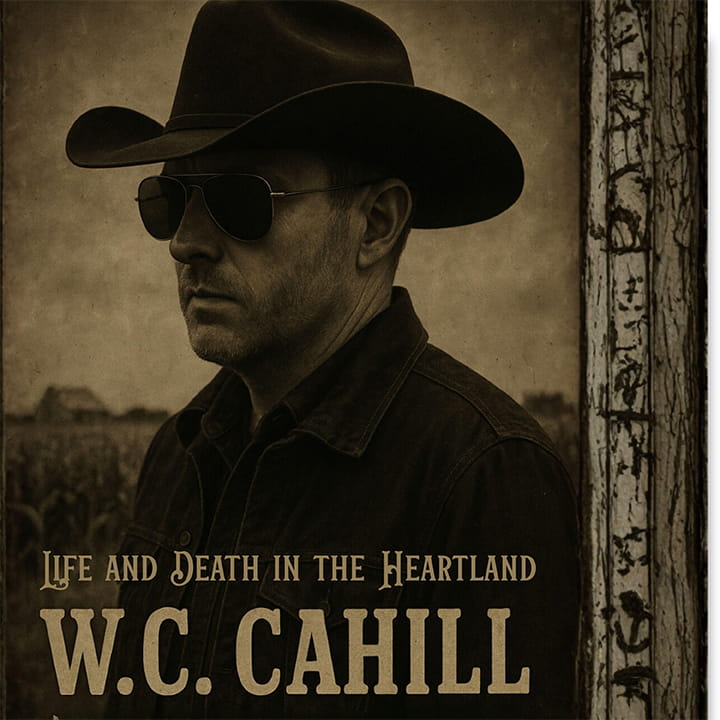
For someone who has never heard you or the album before, how would you describe Life and Death in the Heartland?
I would say it’s a very personal story of my life.
It’s an intimate album in that sense. It’s not really me trying to generalize or speak for everybody. These are my own stories, my own experiences, and my own way of trying to make sense of certain things that happened in my life.
At the same time, I think personal stories are often the ones people connect with the most, because everyone has their own version of loss, regret, hope, memory, and trying to move forward.
Why did this album need to exist?
I think part of it was just therapy for me.
I had these songs and ideas in my head for so long that getting them off my chest and out of my head felt like a relief in some ways. It was almost like I needed to put them somewhere outside of myself.
Some of these songs had been with me for years. Some ideas had been around for decades. At a certain point, it felt like they needed to become something real. Putting these songs and stories out there was a release for me. It was like therapy in song form.
The title Life and Death in the Heartland carries a lot of weight. What does that phrase mean to you personally?
To me, it’s an exploration of all the different ups and downs of life.
Everything that’s living eventually dies. Everything that begins eventually comes to an end. Sometimes that’s literal, in the sense of life and death. But sometimes it’s the end of ideas, dreams, plans, relationships, or the version of the future you thought you were going to have.
For example, I always assumed we’d have the family 80 acres. I used to tell myself, “Well, we’ll always have the 80.” Over the years, I projected all kinds of ideas onto that — what I might do in the future, especially when it came to farming or staying connected to that ground. But even that turned out not to be permanent.
Another big part of the album deals with relationships. Quite a few songs reference a really bad relationship I was in that unfortunately led to a marriage, which then led to a lot of problems, heartache, financial issues, and other things. A lot of these songs explore the aftermath of that.
So the title is about mortality, but not just physical death. It’s about the way all things eventually change, end, or pass away — and what you do with that truth.
Some of these songs go back years, even decades. What was it like carrying those stories around for that long?
I don’t think that makes me special. Everyone has stories. Everyone has ideas. Everyone has things they think about and carry with them.
These just happen to be my personal stories.
At the end of the day, people like to tell stories. They like to talk about themselves, or share some part of themselves with other people or with the world. That’s what people do through
music. They expose themselves a little bit. They become vulnerable and say, “Hey, this is me. This is my life.”
That’s really what this album is. It’s me putting those stories into songs and letting them be heard.
How much of the album is autobiographical, and how much is storytelling drawn from other people, places, or feelings around you?
I would say it’s probably 75 to 80 percent autobiographical.
Even the songs that aren’t directly about me usually have some basis in my own reality.
For example, I included “Danny Boy” on the album because I thought it fit perfectly with the life and death theme. That one is in honor of my dad’s cousin Danny. When I was a kid — maybe 10 or 12 years old — he lived with us for a summer. I know he was struggling in his own personal life, and eventually he died due to alcoholism.
But during that short time he lived with us, he made an impact on me and my brothers and sisters. So even a song like that, which isn’t something I wrote directly about myself, still has a connection to my own life.
That’s how most of the album works. Even when it isn’t strictly autobiographical, it usually comes from something I’ve seen, felt, experienced, or remembered.
Why is the Midwest — or the “heartland” — such an important part of the album’s identity?
The Midwest is literally called “flyover country,” which has always bothered me because it skips over all of us who actually live here. There are millions and millions of people here with our own stories, our own lives, and our own cultural identity, if you want to call it that.
There are a lot of stereotypes about the Midwest — plainspoken, hardworking, all of that — and some of it may be true, but it can also flatten the place and the people who live here.
There are so many songs about Texas. There are songs about the South, California, New York, and all those places. But what about the Midwest?
We’re here too. We’ve got a lot of things to say.
That’s part of why the word “heartland” matters to me. It’s not just a vague patriotic phrase. It’s the actual place where these stories come from. It’s the farms, small towns, back roads, family histories, broken relationships, old dreams, and people trying to keep going.
The album deals with some heavy themes: time passing, loss, memory, small towns, mortality, divorce, regret. Is there hope in it too?
Oh, there’s always hope.
I think that’s wrapped up in the last song, “3 a.m.” Even in the worst times, there are still good times ahead. There’s always the down with the up and the up with the down. It all goes together.
I’m actually a very optimistic person. I don’t think there’s anything wrong with recognizing heartache or loss. That doesn’t mean you’re fixated on those things. It means you’re acknowledging them, and I think acknowledging them can actually give you some sense of freedom.
Even acknowledging your own mortality can be liberating in a way. Not that you want the end to come anytime soon, but realizing that time runs out for all of us gives you an incentive to make the most of what you have.
And personally, I’m someone who has always needed a deadline.
What song on the album feels the most personal to you?
That’s tough, because there are a few.
“Goddamn” is one of them. That song pretty directly tells the story of a marriage ending.
“Mud” is another one. That song really captures my thoughts on the loss of the home ground — the home farm that I thought would always be there. As it turns out, even that isn’t going to be around forever.
And then there’s “3 a.m.,” which comes from the depths of going through a divorce. That period took a real toll on me for a lot of reasons — financial reasons and other things too — but also because of the craziness and drama I had started to think was normal in that prior relationship.
When you’re around things that are kind of insane, you can begin to believe that insane things are normal, even when they’re not.
Those three songs are probably the most true to life, the most personal, and the ones where I feel the most vulnerable.
What kind of listener do you think this album is for?
I think it’s for people who understand that sometimes it’s nice to hear a sad song when you’re sad.
Not that these are all sad songs. There are a couple of fun songs on there too. But I think the album is for people who enjoy a traditional style of country music, which this definitely is, and for people who enjoy a story.
A lot of the songs tell stories. I hope it connects with people who want to engage with the lyrics, who want to think a little bit when they’re listening to music, and who care about the message.
The beat matters, of course, but sometimes the real connection is in recognizing something in the song that feels similar to something you’ve gone through yourself.
I hope the album finds people in those moments and connects with them.
When someone finishes listening to Life and Death in the Heartland, what do you hope they feel?
I hope they feel like they’re not alone.
When you’re going through a hard time, it can help to know other people have gone through something similar. I hope people feel understood, or at least feel like someone else has been there too.
And I hope they feel a little bit of hope.
The album ends with the idea that even if you’re as far down as you can get, there are still good times up ahead, even if you can’t see them in the moment. That’s one of the ideas in “3 a.m.”
Hopefully, people feel better than they did before they started listening. That’s always a goal.
Official Website: https://www.wccahill.com/
Instagram: @wccahillmusic
YouTube: @willycahillmusic