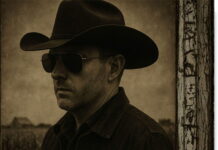
He doesn’t have a single stream and still attained a Nashville producer and recording sessions at the Historic RCA Victor Studios.
Mason Bolt is cutting his debut at RCA Victor on Music Row, in the complex where the Nashville Sound was built; where Elvis Presley, Dolly Parton, Waylon Jennings and Willie Nelson made records that rearranged American music. It is a working room, not a museum. It is also an unusual place for an artist with zero releases to be standing, and he knows it.
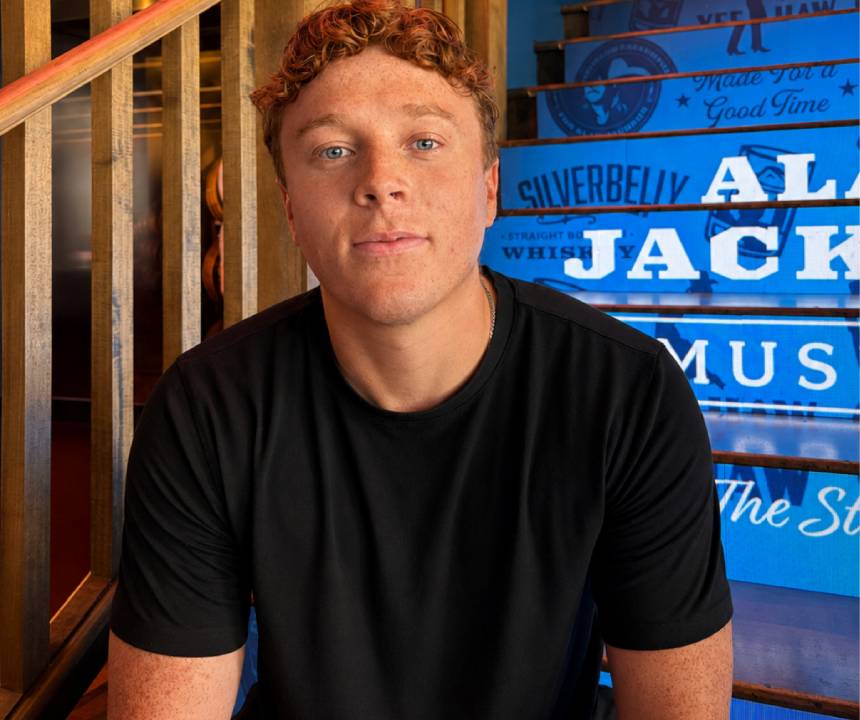
That ledger runs backwards by every rule the last decade wrote. An artist is supposed to arrive with the numbers first, the saves and the skips and the clip that traveled, because the numbers are what buy the room. Bolt did it in the original order. He won the room in person, and when the numbers come this fall they will be confirming a verdict Nashville has already returned.
The producer is John Salaway, and Salaway is not a small hand to be holding. He is a Top-20 Billboard charting songwriter and a multi-instrumentalist whose stage credits run through Peter Frampton, Ben Folds, Anderson East and Denny Laine of Paul McCartney & Wings. He has worked with a long list of Grammy-winning producers and engineers, among them Geoff Emerick, who recorded and mixed the Beatles’ Revolver, Sgt. Pepper’s Lonely Hearts Club Band and Abbey Road. That is a lineage nobody can purchase, and it is now sitting behind the glass on a debut single by a bartender who has never released a song.
“I personally know how hard it is to leave your home, family and friends to pursue the Nashville dream,” Salaway says. “Mason has proven that he’s all in and ready to work hard to build a career in music. I feel lucky to have met him right as he’s getting started so I can help open doors for him and produce world-class music for him at RCA Studios with Eddie Gore. Eddie and I have the same ethics in life, where we spend just as much time on music for new artists as we do for famous artists. We’re going to produce music for Mason that sonically competes with anything on the charts.”
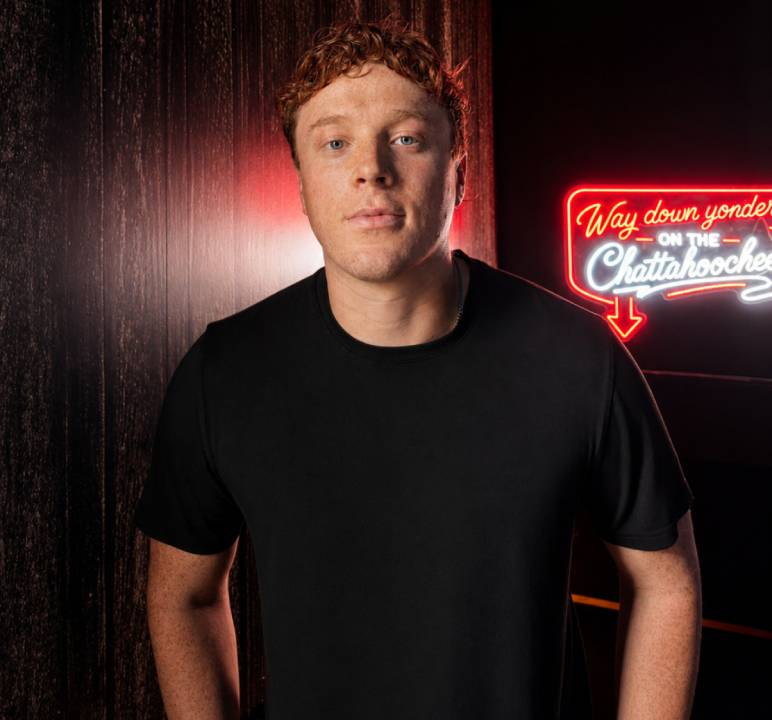
That is how Bolt came to play his first writers round, a slot Salaway arranged for him at Eclectric Records’ Jaded Jams, the songwriter showcase curated by label owner and artist Ariel Jade. It was the first time anyone in this city had heard a Mason Bolt song. He played the one that measures a relationship in weather, and the room went with him. Nothing about the night was a discovery. The people backing him were already backing him. It was the night a room full of strangers independently arrived at the same conclusion. “Putting yourself out there in the most genuine way, without pretense and without chasing trends, is what makes you stand out in Nashville’s sea of aspiring creatives,” Jade says. “That’s exactly what Mason Bolt is doing.”
Nashville used to run entirely on that sequence. A writer played a room, the people who make records were sitting in the audience, and the record came after the reaction rather than in front of it. What makes Bolt worth watching is not that he’s talented, because this city is oversupplied with talent. It is that his career is being assembled in the old order, on evidence gathered by people who were physically present.
He is Mason Boltinghouse, and until roughly two years ago the honest answer to what he did was sports: football, basketball, baseball, straight through high school, coached at every level by his father. There was a chance to play college baseball waiting on him. He turned it down for family reasons, and into the vacancy that left went a piano he taught himself to play and a voice he taught himself to use, neither of which has had a lesson spent on it. Florida holds the last six years of his life: college, a fraternity, three full-time jobs running at once, then Orlando. The guitar came last, eighteen months ago, and nearly the entire catalog postdates it.
Before the guitar there were poems, and that fact explains more about his writing than any influence he can name. His parents divorced in 2022, and he handled it the way he had always handled things, which was to file it somewhere internal and say nothing. “I’ve always kind of kept my emotions to myself,” he says, a sentence that sits strangely beside the man his friends describe: the loudest person in any room, hyper, joking, first to introduce himself. Both are true, and the poems were the only channel that ever ran between them. The guitar gave that channel a melody, a chorus, and somewhere to put a crowd. He wrote “Further Than Fixin’” in a dark room with a single candle burning, and it remains the lyric he says he’s closest to.
The stage is new. The work isn’t. He writes most days now, on schedule, whether or not anything arrives, “even if the lyrics and songs aren’t perfect,” he says. Ideas get recorded into his phone the second they surface, a melody hummed in a parking lot, a line caught mid-shift. The hardest part of the job, by his own account, is accepting he cannot write the perfect song every time no matter how badly he wants to. “Sometimes I can write a really good song in one night, and other times I’m stumped for days.” That is a working writer’s complaint, not a beginner’s. So when the decision came, he made it all at once, and drove to Nashville alone, into a city where he knew nobody, took a bartending job to cover rent, and started signing up for rounds. “Always take that leap of faith and bet on yourself,” he says.
He did not do it unbacked. His two sisters are his closest friends, and his best friends Aidan, Trey and Malachi have been on every step of this, Trey in particular the one who straightens him out when it’s needed. “They’ve all been so supportive of my dreams,” he says. The courage was borrowed from those four people long before it was his, as well as the support from his mom, dad, and stepdad, who he makes sure to mention his gratitude for.
The debut single tells the story of running into someone you keep failing to avoid. Bolt wrote it upbeat on purpose and built it with three different choruses, each one advancing the encounter instead of repeating it. That is architecture, not mood. “I took something sad and turned it into something uplifting,” he says, and for a writer eighteen months into owning a guitar, the more revealing thing is that he already treats a chorus as a place to move the story rather than a place to rest in it.
His references run conventional until they don’t. Morgan Wallen’s reading of “Cover Me Up,” Jason Isbell’s song arriving to him secondhand, is what made him want to write country at all. Chris Stapleton is the ceiling for what a voice can hold and, tellingly, his model for professional conduct: Bolt watched him work a stage with no theatrics and took notes on the restraint as closely as the singing. Zach Bryan’s ‘American Heartbreak’ showed him what a lyric can carry with nothing produced on top of it. And then Sam Cooke, whose plainness about love he keeps returning to, the influence nobody guesses and the one that says the most about where this is actually headed.
He assigns none of it to himself. The best advice he has ever received runs five words long – “Put it in God’s hands” – and he applies it to the whole sequence. “Without Him, I am nothing,” he says. “God has been able to guide me into getting started this quickly.”
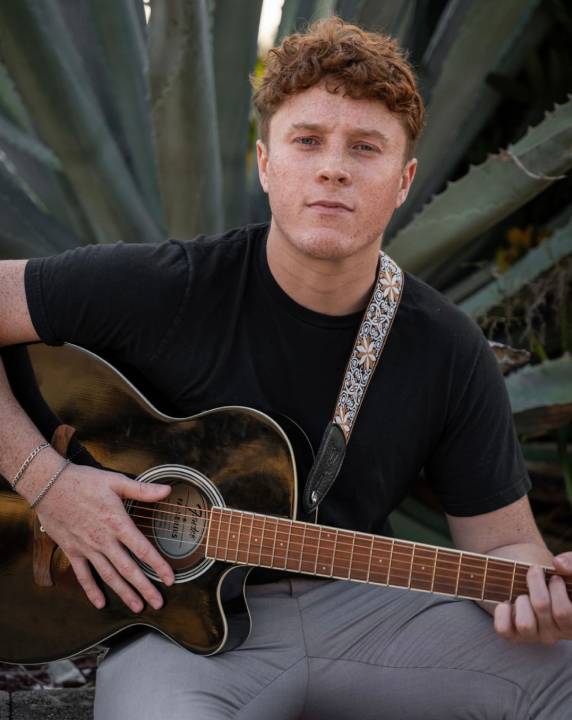
Ask him what he’s still working out, and he’ll tell you he doesn’t know which songs to release, which rooms make sense, or whether Nashville is where he lands. He’s been here weeks, not years. He still bartends.
But the thing most artists spend those years chasing, a room of strangers deciding in real time with no counter telling them what to think, already happened to him before he had a single song out. This fall, everyone else gets a vote.